Views: 0 Author: Site Editor Publish Time: 2026-08-26 Origin: Site


The increasing prevalence of fibrous waste—specifically "flushable" wipes, rags, and synthetic strings—has created a systemic ragging and clogging crisis in raw and partially treated wastewater infrastructure, leading to unacceptable downtime and maintenance costs. Standard non-clog centrifugal pumps, which are designed primarily for liquids and soft suspended solids, frequently fail when processing high-tensile fibrous materials. The fibers wrap around the impeller vanes, causing mechanical binding, severe vibration, and eventual motor failure. This forces engineers and facility managers to evaluate specialized mechanical reduction solutions to protect downstream equipment. Understanding the exact mechanical shearing process of a cutter-equipped submersible pump is critical for specifying the correct equipment, avoiding over-engineering, and ensuring long-term operational reliability in severe-duty rotodynamic applications.
Mechanical Shearing: Cutter pumps utilize a specific combination of a rotating impeller blade and a stationary cutting plate to shear fibrous waste into manageable pieces before it enters the pump volute, maintaining a consistent slurry profile.
Application Specificity: Unlike grinder pumps that macerate waste into a fine slurry for high-head/low-flow systems, cutter pumps are engineered to maintain higher flow rates while preventing impeller ragging from long fibers.
Material and Durability: Specifying a stainless steel cutter sewage pump is often necessary for industrial or highly corrosive environments to prevent premature degradation of the cutting mechanism.
Operational Trade-offs: Integrating cutter mechanisms introduces specific maintenance requirements, including periodic blade clearance adjustments and higher initial torque demands during the cutting phase.
The defining feature of a cutter pump lies in its suction port architecture. Before wastewater ever reaches the primary pumping hydraulics, it must pass through a specialized mechanical reduction zone. This zone consists of a stationary serrated cutter ring securely mounted to the pump casing and a rotating cutter blade attached directly to the extended impeller shaft. As the shaft spins, the rotating blade sweeps across the stationary serrations with extremely tight tolerances. In field applications, we typically see this clearance set between 0.1mm and 0.3mm. This precise alignment creates a scissor-like shearing action.
Instead of attempting to crush or pass heavy debris whole, this mechanism actively slices long, stringy materials like sanitary wipes, textiles, and plastic bags. When a mass of synthetic wipes enters the wet well, the velocity of the fluid draws it toward the suction port. The shearing action breaks the high-tensile strength of the fibers immediately upon contact. The waste passes through this series of rotating and stationary plates, ensuring a consistent slurry profile before it enters the main pump housing. By reducing the physical length of the fibers at the inlet, the pump eliminates the risk of materials wrapping around the impeller hub and binding the rotational movement.
Once the fibrous material is chopped into smaller, manageable segments, it transitions from the cutting plate into the centrifugal pump hydraulics. The fluid dynamics within the pump volute change slightly due to the presence of the cutting mechanism at the inlet. The chopped slurry must enter the eye of the impeller smoothly without causing cavitation or excessive turbulence. To handle this newly sized solid waste alongside standard suspended solids, cutter pumps typically utilize semi-open or channel impellers.
Semi-open impellers feature vanes that are not enclosed by a front shroud. This open design allows the chopped debris to slide along the volute casing and exit through the discharge port without getting trapped. Channel impellers provide a wide, unobstructed pathway for the fluid and solids to travel. These rotodynamic systems are carefully engineered to facilitate the passage of the sheared solids without compromising overall hydraulic efficiency. The design ensures that the velocity of the fluid remains high enough to keep the solids suspended, preventing them from settling and accumulating within the pump casing during low-flow periods.
The mechanical action of shearing heavy fibrous bundles introduces significant dynamic loads on the pump motor. When the rotating blade encounters a dense mass of rags or wipes, it experiences sudden mechanical resistance. This resistance translates into momentary spikes in motor load and electrical current draw. The motor must possess sufficient kinetic energy and rotational force to power through the obstruction without stalling. If the motor lacks the necessary torque, the blade will jam against the stationary ring, tripping the breakers in the control panel.
Robust motor sizing is an absolute necessity for cutter applications. Engineers specify motors with high starting torque capabilities, often utilizing NEMA Design B or C characteristics, along with heavy-duty bearings to absorb the radial loads generated during the cutting phase. Additionally, comprehensive thermal protection is integrated into the motor windings. If a particularly stubborn object temporarily jams the cutter, the motor will draw excessive locked-rotor amps, generating rapid heat. Thermal overload relays and moisture sensors protect the stator from catastrophic failure, shutting down the pump before the Class F or Class H insulation degrades.
Grinder pumps utilize a rotating cutting wheel located at the suction port, often resembling a star-shaped blade rotating against a stationary ring with numerous small holes. This mechanism macerates garbage, sanitary waste, and organic solids into a fine, particulate slurry. The resulting fluid resembles a thick liquid, which can be easily transported through small-diameter pipes over long distances.
These pumps are ideal for pressure sewer systems requiring low flow and high head, such as residential tie-ins to municipal force mains or remote cabins pumping up to a gravity sewer. However, grinder pumps have distinct limitations. They are highly prone to jamming when encountering heavy inorganic debris, such as rocks, metal hardware, or thick plastics. Furthermore, the fine maceration process restricts the intake area, resulting in a significantly lower overall flow capacity compared to other pump types. You cannot use a grinder pump to drain a high-volume municipal wet well during a storm event; it simply will not move enough water.
Chopper pumps integrate the cutting action directly into the impeller vanes. The leading edges of the impeller are sharpened and hardened, rotating closely against a stationary cutting bar or suction plate. As the material is drawn into the pump, it is chopped continuously as it moves through the hydraulics. This means the cutting happens inside the volute rather than just at the inlet.
This design is deployed primarily in heavy-duty industrial and agricultural applications. Chopper pumps excel at handling thick slurries with high concentrations of irregular debris, such as slaughterhouse waste, agricultural runoff, or heavy industrial processing fluids. The continuous chopping action throughout the volute ensures that even the most stubborn materials are broken down. However, this aggressive internal cutting comes at the cost of reduced hydraulic efficiency and much higher power consumption compared to standard centrifugal designs.
Cutter pumps strike a balance between solids handling and flow capacity. The mechanism shears at the suction inlet, protecting a standard non-clog impeller located immediately behind it. This configuration allows the pump to process both standard suspended solids and long fibers simultaneously without sacrificing the large internal clearances needed for high volume transfer.
These pumps are the standard choice for municipal lift stations, commercial buildings, and institutional facilities where high flow is required, but fibrous waste is a known variable. By isolating the cutting action to the inlet, the main hydraulics remain optimized for moving large volumes of water efficiently. The coarse shearing action is sufficient to prevent ragging while maintaining the high gallons-per-minute (GPM) output necessary to keep wet wells pumped down during peak usage hours.
Pump Category | Mechanical Action | Primary Field Application | Flow & Head Characteristics | Main Limitation |
|---|---|---|---|---|
Grinder Pump | Macerates waste into a fine slurry using a rotating wheel and perforated ring. | Residential pressure sewers, low-volume commercial tie-ins. | Low Flow (GPM), High Head (TDH). | Prone to jamming on hard inorganic debris; cannot handle high inflow rates. |
Chopper Pump | Chops material continuously using sharpened impeller vanes against a cutter bar. | Agricultural manure pits, slaughterhouses, heavy industrial slurries. | Moderate Flow, Moderate Head. | High energy consumption; lower hydraulic efficiency due to internal friction. |
Cutter Pump | Shears fibrous waste at the suction inlet before it enters the main volute. | Municipal lift stations, hospitals, large commercial facilities. | High Flow, Moderate Head. | Cutting plates require precise clearance calibration to remain effective. |
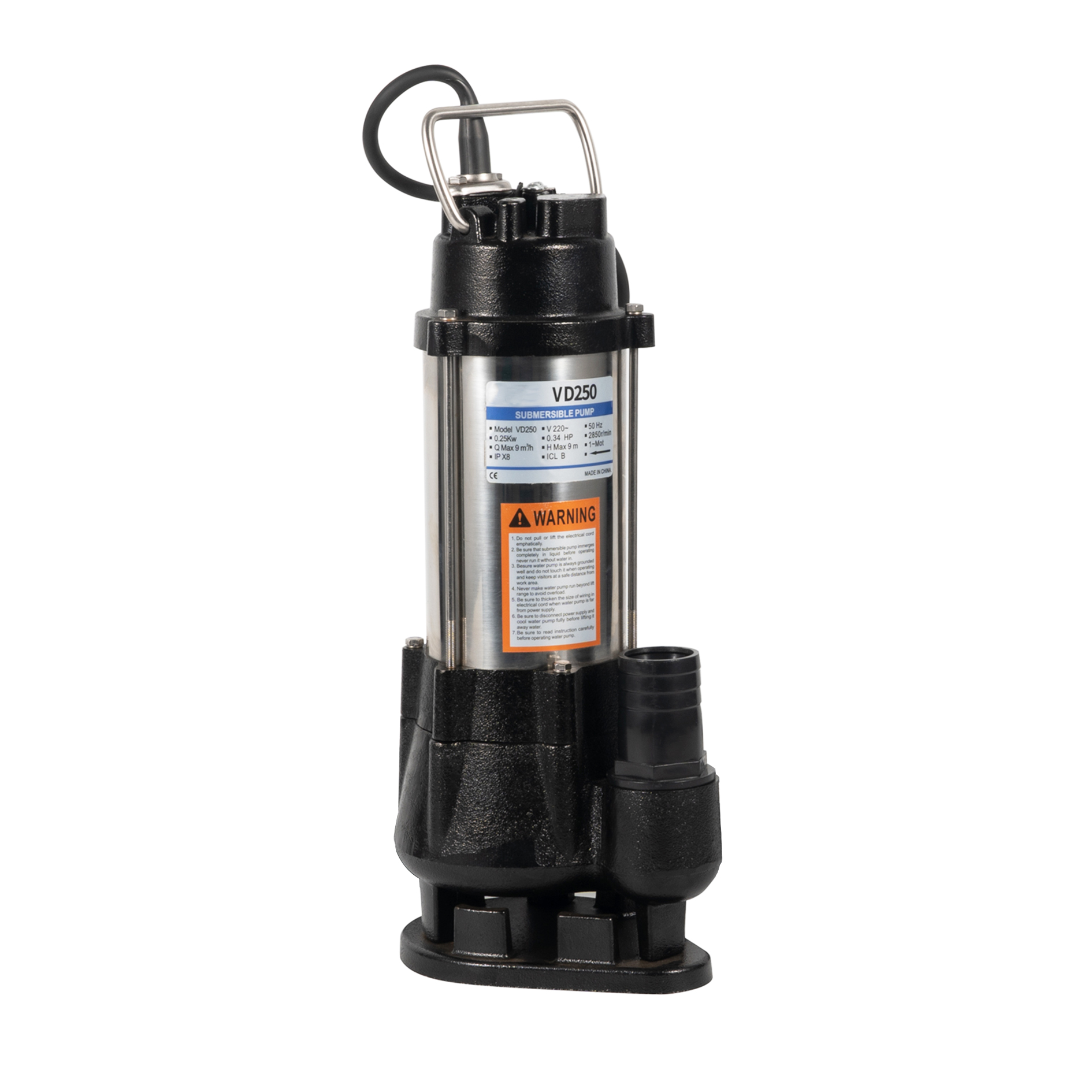
Selecting the correct sewage and drainage submersible pump requires a strict decision framework based on specific operational parameters. The primary metric is the required gallons per minute (GPM) to handle peak inflow during heavy usage periods or storm events. Next, engineers must determine the maximum allowable solid size for the discharge pipe to prevent blockages downstream in the force main. Finally, analyzing the ratio of soft suspended solids to high-tensile fibrous waste dictates the aggressiveness of the required cutting mechanism.
The addition of a cutting plate impacts the pump's performance curve. The restriction at the suction inlet slightly reduces the overall hydraulic efficiency compared to a standard non-clog pump with a fully open suction port. Engineers must account for this efficiency loss when reading the pump curve, ensuring the selected model still meets the system's total dynamic head (TDH) requirements. You have to plot the system curve against the modified pump curve to find the true operating point. Furthermore, selection factors differ between raw wastewater intake, which contains heavy, unpredictable solids, and partially treated effluent transfer, which primarily requires high-volume movement with minimal cutting.
Wastewater environments are inherently corrosive and abrasive. Assessing the operational necessity of a stainless steel cutter sewage pump is critical in applications involving high acidity, industrial chemical runoff, or saline environments. Standard cast iron components degrade rapidly when exposed to low pH levels, high chloride concentrations, or heavy hydrogen sulfide (H2S) gas buildup in poorly ventilated wet wells. This degradation leads to premature failure of the pump casing and internal hydraulics.
The cutting mechanism itself demands superior metallurgy regardless of the casing material. The stationary rings and rotating blades are typically cast from hardened tungsten carbide or high-chrome iron. Tungsten carbide offers exceptional wear resistance against the abrasive grit, sand, and gravel that frequently accompany fibrous waste in municipal sewer lines. Comparing the wear resistance of these hardened materials against standard cast iron components reveals a significant extension in the operational lifespan of the cutting edges. If you use standard steel for the cutter plate, the sand in the wastewater will round off the sharp edges within months, rendering the shearing action useless.
Cutter pumps do not operate in isolation; they must integrate seamlessly into broader wastewater networks. In many municipal layouts, these units serve as the primary lift mechanism, pulling raw sewage from deep wet wells and shearing the fibrous waste. Once the waste is processed into a manageable slurry, the effluent is often transferred to a high head dewatering pump for deep-well extraction or long-distance transport through extensive force mains.
System compatibility dictates how easily maintenance crews can service the equipment. The selected pump must align with existing guide rail systems—typically 2-inch or 4-inch stainless steel pipes—allowing personnel to hoist and lower the unit without entering the hazardous wet well environment. The auto-coupling bracket on the pump must form a perfect, leak-free seal with the base elbow on the discharge pipe to prevent pressure loss. Additionally, the pump's electrical characteristics must match the existing control panels, ensuring that the motor starters, overload relays, and seal leak detectors function correctly within the established infrastructure.
Facility managers must acknowledge the reality that cutting edges dull over time. This degradation accelerates significantly if the pump is exposed to abrasive grit, such as sand, gravel, or glass, alongside the fibrous waste. As the edges round off, the scissor-like shearing action degrades into a tearing action. Tearing requires significantly more torque from the motor and drastically increases the risk of fibrous bundles slipping between the plates and jamming the shaft.
Strict maintenance protocols are required to manage this wear. Technicians must periodically pull the pump to inspect the cutting mechanism and adjust the clearance between the rotating blade and the stationary plate. Maintaining the factory-specified clearance is essential to preserve cutting efficiency, minimize motor load, and prevent shaft binding. The standard field procedure for this calibration involves the following steps:
Isolate the power supply at the main control panel and engage strict lockout/tagout (LOTO) procedures before opening the wet well hatch.
Hoist the pump using the designated lifting chain and guide rail system, ensuring it clears the auto-coupling bracket smoothly.
Clean the suction port thoroughly with a pressure washer to remove residual sludge and expose the cutter ring and rotating blade.
Measure the gap between the rotating blade and the stationary ring using a standard feeler gauge to determine if it exceeds the manufacturer's maximum tolerance.
Remove the retaining bolts, extract the rotating blade, and add or remove precision shims on the shaft to restore the exact factory-specified clearance before reassembly.
Integrating a mechanical cutting stage introduces an unavoidable energy trade-off. Cutter pumps generally consume more power than standard centrifugal pumps of the same horsepower. The mechanical work required to shear dense fibrous bundles draws additional electrical current, reducing the overall wire-to-water efficiency of the pumping system. You are trading a small amount of electrical efficiency for a massive reduction in manual un-clogging labor.
Operators implement specific mitigation strategies to manage these energy costs. Utilizing Variable Frequency Drives (VFDs) allows facilities to optimize energy use during non-peak flow periods. By slowing the pump speed during low-inflow hours, the system conserves energy. However, VFD parameters must be carefully programmed. If the frequency drops too low, the motor will not deliver sufficient starting torque to power through any fibrous bundles resting against the cutter plate when the pump initiates its cycle. The VFD must be set to provide a rapid ramp-up to full torque to clear the cutter plate before settling into a lower operational speed.
Expanding wastewater infrastructure into remote areas presents unique power challenges. Engineers frequently evaluate the feasibility of deploying a solar DC submersible pump equipped with a cutter mechanism for off-grid municipal lift stations or remote agricultural processing facilities. Solar power offers a practical solution where extending the municipal electrical grid is cost-prohibitive or geographically impossible.
However, solar-powered cutting applications face specific voltage and starting torque challenges. Shearing heavy fibrous waste requires massive instantaneous torque, which creates a sharp spike in electrical demand. Standard solar arrays and basic charge controllers often struggle to deliver this sudden inrush current, leading to severe voltage drops and pump stalls. Successful deployment requires oversized solar arrays, advanced Maximum Power Point Tracking (MPPT) controllers, and robust battery banks or supercapacitors designed specifically to handle the high transient loads generated by the mechanical cutting action. The cable sizing must also account for voltage drop over long runs from the solar array to the wet well.
Cutter submersible pumps represent the most effective engineering choice for high-flow wastewater applications plagued by modern fibrous materials. In environments where standard non-clog pumps fail due to severe ragging and grinder pumps cannot meet the necessary volumetric flow requirements, the coarse shearing action of a cutter pump provides the necessary balance of mechanical reduction and hydraulic efficiency. By processing wipes and textiles directly at the suction inlet, these pumps protect downstream infrastructure, maintain consistent flow rates, and drastically reduce emergency maintenance calls.
To ensure successful implementation and long-term reliability, execute the following next steps:
Pull historical maintenance logs to quantify the frequency of ragging incidents and identify the specific types of fibrous waste entering the wet well.
Calculate the required peak flow rate and total dynamic head for the lift station to establish the baseline hydraulic performance requirements.
Specify the exact metallurgy for the cutting plates based on a chemical analysis of the wastewater, defaulting to hardened tungsten carbide for high-grit environments.
Verify that the existing motor starters and thermal overload relays in the control panel can handle the increased inrush current required by the cutting mechanism.
Confirm physical compatibility with existing guide rail systems, auto-coupling brackets, and discharge piping before finalizing equipment procurement.
A: A cutter pump provides coarse shearing at the suction inlet, breaking down long fibrous materials while maintaining high flow rates suitable for municipal lift stations. A grinder pump uses a macerating wheel to grind waste into a fine particulate slurry, designed specifically for low-flow, high-head pressure sewer systems.
A: No. Cutter pumps are engineered specifically to process organic matter and high-tensile fibrous waste like wipes and rags. Hard inorganic solids such as rocks, metal hardware, or heavy glass will severely damage, chip, or jam the hardened cutting plates, requiring immediate replacement.
A: Lifespan depends heavily on the concentration of abrasive grit in the wastewater. In typical municipal applications, the pump requires annual inspection. Technicians adjust the clearance shims to maintain cutting efficiency, with full blade replacement usually occurring every three to five years depending on wear.
A: Yes, slightly. The stationary cutting plate restricts the suction inlet, causing a minor loss in hydraulic efficiency compared to a fully open non-clog pump. Engineers must account for this slight reduction in flow rate and head pressure when reading the manufacturer's performance curve.
A: Cast iron is the standard material for typical municipal raw sewage applications. Stainless steel is only mandated for specialized environments involving highly corrosive fluids, extreme temperatures, low pH levels, or specific industrial chemical runoff that would rapidly degrade cast iron components.
A: Yes, but it requires precise electrical engineering. The system must utilize appropriately sized solar arrays, advanced MPPT controllers, and heavy-duty battery banks capable of delivering the high instantaneous starting torque required to shear dense fibrous bundles without causing a voltage drop.


